

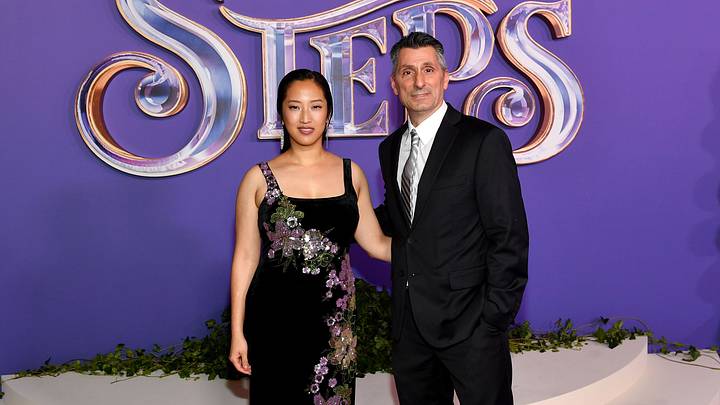
People have seen many versions of Cinderella over the years, from Disney’s classics to modern musicals and big live-action films. But Netflix’s animated musical Steps takes a new approach, focusing on Lilith and Margot instead of the usual princess and glass slipper.
The movie reimagines the so-called "evil" stepsisters as misunderstood outsiders in a kingdom that values conformity. With its heartfelt look at blended families and a bold pop soundtrack, Steps brings fresh energy to a familiar story. Before the film’s release on Friday, Netflix Life spoke with directors Alyce Tzue and John Ripa about how they combined their creative visions, created a believable family dynamic, and gave this fairy tale a modern pop twist.
Steps doesn't just redeem classic villains—it reframes Lilith and Margot as misunderstood outsiders. You both brought different instincts to this, from Alyce's personal childhood experiences to John's background in sweeping fantasy. How did those perspectives come together to flip the Cinderella story on its head?
Alyce Tzue: Growing up in a homogeneous little white town in Jersey, I felt like an outsider looking at the other little girls who spoke perfect English and always looked like they had their lives together. I felt like I couldn't quite find my happily ever after, or I didn't believe I would. With Lilith and Margot, I tried to channel that sense of vulnerability and resentment, and that feeling of not understanding why, even though I wear my heart on my sleeve and have a lot to offer, I don't get the magic and don't quite feel like I belong in this kingdom. Hopefully, audiences will feel a sense of relatability and authenticity in that respect.

John Ripa: So, I started as a 2D animator, and I think one of the things I bring from some of those experiences as an animator was trying to understand the characters in a way that they're very real to you. So, we don't treat these characters like cartoons. We treat them like people we actually know, love, and respect. Bringing that kind of understanding into it and having Alice's influences and story to help us understand them. However, I draw, and I don't really write, so I spent a long time trying to understand how to take an expression, an image, a composition, or a moment and connect it with an audience.
Having had a lot of experience over the years in animation and story, I tried to bring what I've learned about connecting with an audience into it and get them inside a character so they're with them on the journey, rather than observing from the outside. That way, they're feeling with the characters, and that's the way I've brought my experience into it.

Speaking of connecting, fairytales often deem "steps" as evil. How did you approach the dynamic between Lilith, Margot, and Cinderella to make a blended family feel genuine for modern audiences?
Tzue: The blended family aspect was important to us because, as John said, we wanted to portray these characters in a real way and not shy away from the struggles that people from different backgrounds and cultures might experience for the first time. When these two families meet, things seem quite ideal, but then the outside world gets in the way.
This is a kingdom full of conformists who prioritize a certain graceful, rule-abiding fairy-tale archetype. Initially, young Lilith just doesn't fit that. I think what we're trying to say is that none of these characters are purely evil or purely good. We're trying to get at the layers of what might make someone act a certain way. For example, when Lilith puts up her emotional walls, she can be spiky and not very nice to Cinderella. Ultimately, there is a reason for that, and we dig beneath the layers to show it so people can empathize with these characters.
So, Netflix subscribers will be thrilled to see Ali Wong and Young Mazino reunite again after being on Beef. How did having that on-screen rapport help in the process? And what was one of the funniest notes you had to give the animation team to make a fairytale troll look charming?
Ripa: Well, it's interesting because when they record the voices, they're actually not together in the same room. They record at different times. But actually, it was Ali who first suggested Young for the troll Gef role to us. When we heard him, we were like, "Yeah, he is perfect for it." So, it's nice that they already had this connection and chemistry.
Tzue: One of the funniest notes that we gave our animation team was to make Gef unintentionally hot. He doesn't know that he's one hot hunk of a troll, but the animators could sometimes, like, frame his bicep like he's swiping his hair, and you happen to see a great silhouette of his bicep. He has his broad shoulders. There are little moments where he is so unaware that he looks amazing, but the animators have orchestrated that thanks to our note.

So, between Justin Tranter's original tracks and artists like JENNIE and Needle Drops like Olivia Rodrigo's "Brutal," this soundtrack has serious edge. Why was a fierce modern pop sound the right heartbeat for this fairytale?
Tzue: I feel like we have a bunch of characters that are larger than life. Their personalities want to burst out of the box. It felt like pop anthems were the right way to go. I feel like, and John can speak to this as well, that Justin Tranter is an extremely talented songwriter who can work with different personalities to embody different characters and still make each one a banger. That's a very rare talent.
Amanda Seyfried also has such an iconic musical voice, and here she's playing the "goody-two-shoes" Cinderella. How did you use her singing a track like "Smile and a Song" to play with that classic princess trope?
Ripa: It's fun because we're talking about how each song represents the characters in some way and that moment. "A Smile and a Song" represents a flawed philosophy for Cinderella: that you can sweep things under the rug and a smile and a song can solve everything. Amanda just crushed it. She is not only an incredible actor with comedy, heart, and emotion, but she also has an incredible voice. It's hard to sing, perform, and be a character in it at the same time. It's really hard to do, but she really nailed it. And it's a very funny, fun, lively, bright kind of song.

It was. It seemed like a classic princess trope. So, streaming audiences often like pausing scenes and re-watching movies to catch hidden details. Are there any visual Easter eggs or classic throwbacks to other classic fairy tales tucked into Steps that Netflix fans might see?
Tzue: You are asking the right questions, Laura. We thought a lot about the fact that, yes, on Netflix, you can pause, rewatch, and look at frames again. I'll mention two, and John will know which one. There are often visuals that are a little more complex, and you need to pause to take a look. For example, Young Lilith's suitcase that she's carrying in the beginning actually has some Easter eggs in terms of where they've come from and where they've been. There's also a map later in the movie where, if you pause at the right time, you can see what Lilith has drawn on it and what she's commented about various places they've been on the journey so far.
Ripa: There are some other little ones too. One might not be so fairytale-like, but in some shots, the animators have hidden a platypus. So, there's a platypus at the beginning of the movie which doesn't quite fit into the fairytale animals. But it is a tribute to our producer, Jane, who loves platypuses.
The other is that, as the first end-to-end film for Netflix, they have studios in Sydney and Vancouver, and so, as a little tribute to the Sydney studio as well, there's a platypus in there. We don't even know where they're hidden in the movie, but the animators hid them in some scenes somewhere in the background or maybe in a tree. So, if people find it, let us know on Instagram.

And finally, with all those bangers on the soundtrack, which track from Steps is your ultimate go-to karaoke song?
Tzue: I have a favorite one for karaoke, and I'll say I have tried it in the privacy of my own bedroom. Emme’s "The Understudy" is just such an anthem for underdogs, and it has a rock and punk sensibility, and you can just go all out with it and channel every cathartic, angry emotion you've ever felt. If the world has ever treated you unfairly, you can shout it out. There's a big scream at the end that Emme does flawlessly. She's done it live. I don't know how she hits that whistle tone, but she does, and everyone should check it out. Try it for karaoke, as long as you're not blowing everyone's eardrums out.
Ripa: You can probably tell from my voice that I cannot sing at all. You will not find me doing karaoke unless it's by myself in the car on my commute or in the shower. "The Understudy" that Alice talked about stays with you. If I'm going to sing one, I'm going to go with "Meet Me on the Dance Floor." That is really fun, and I can embarrass myself doing that one.
Steps premieres on Netflix on Friday, November 20.
 Add us as a preferred source on Google